Today: Mon Nov 16, 2026MethodologyCorrectionsSource policyAboutResearch Desk
Home › European Migration and Internal Security › Riot police deployed at Poland's Constitutional Tribunal as...
European Migration and Internal SecurityDeveloping

Riot police deployed at Poland's Constitutional Tribunal as dispute over its leadership escalates
Compiled by IPR12 sources66 attributed claimsUpdated Nov 15, 2026
Report a problem
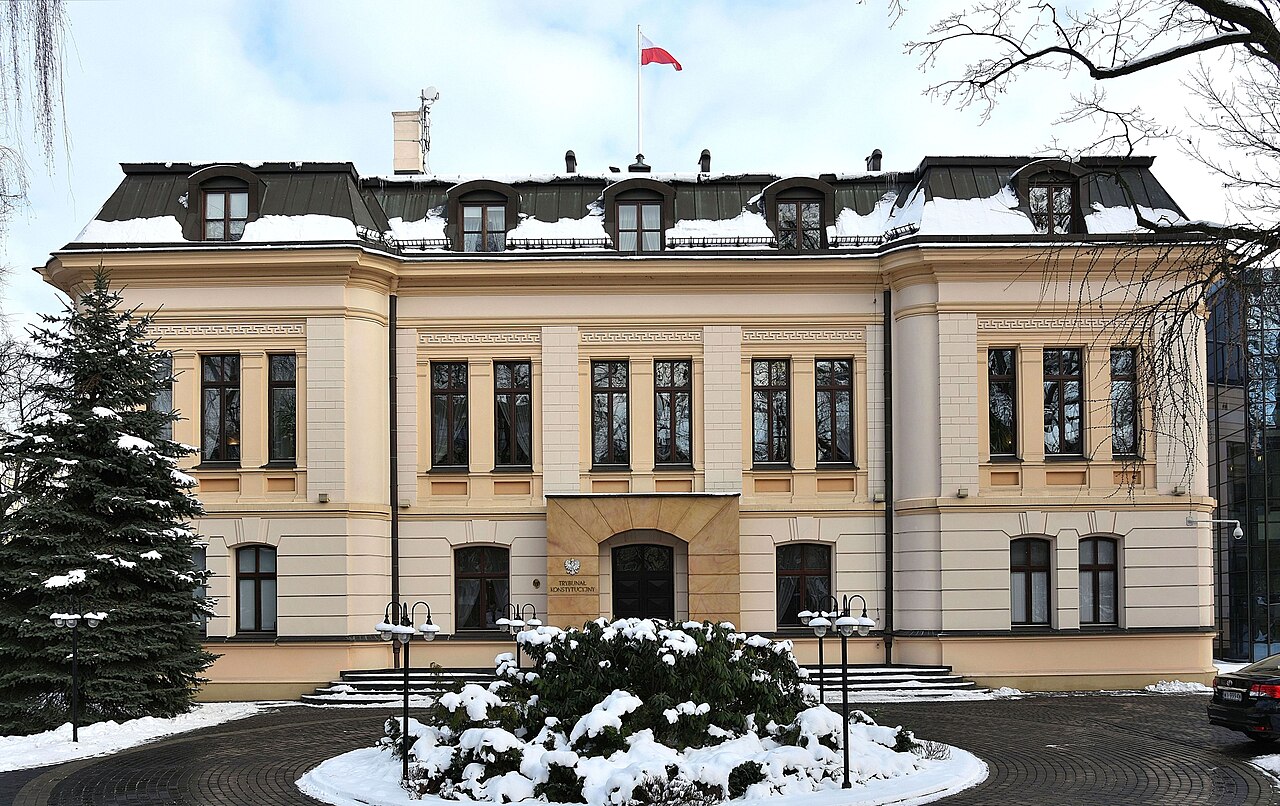
Seat of the Constitutional Tribunal of Poland, photographed in winter 2016 (file photo)
Seat of the Constitutional Tribunal of Poland, photographed in winter 2016 (file photo). Photo: Adrian Grycuk (CC BY-SA 3.0 pl, via Wikimedia Commons)
First recordWhat IPR recorded that day. What has happened since is under Updates since the first record.

On October 30, 2026, Judge Anna Korwin-Piotrowska, one of the judges elected by the Sejm this year, ordered the one-month suspension of Constitutional Tribunal President Bogdan Swieczkowski and Vice-President Bartlomiej Sochanski, according to the International Commission of Jurists. Riot police were deployed at the court in Warsaw the same day.[1][2]

The government of Prime Minister Donald Tusk defends the move as restoring the rule of law. Swieczkowski, six other judges and President Karol Nawrocki reject it as unlawful, and no court has ruled on the dispute.[2][1]

Suspension and police deployment

According to the Warsaw police, as reported by the ICJ, officers arrived at the Tribunal after Korwin-Piotrowska reported possible threats to the safety of judges and staff. BBC News reported that riot police were deployed to prevent demonstrators from entering the building as supporters of the opposition Law and Justice party (PiS) gathered outside.[1][2]

The same day, Justice Minister and Prosecutor General Waldemar Zurek said he had asked for Swieczkowski and Sochanski to be stripped of immunity from prosecution, and the ICJ reported that he submitted five motions to the Tribunal seeking consent to open criminal proceedings against them.[2][1]

Government and opposition accounts

Tusk wrote that restoring the rule of law was the government's duty and required decisive action, and Zurek later told broadcaster TVN, as reported by Notes from Poland, that Korwin-Piotrowska's actions were the only way to rebuild the independence of the tribunal.[2][3]

The Tribunal, in a social media post quoted by the BBC, said the two judges remained its legally appointed senior justices and that those taking part were committing the crime of a coup d'etat. The ICJ reported that Swieczkowski and six other judges declared the orders unlawful while Korwin-Piotrowska assumed the role of acting head.[2][1]

President Nawrocki entered the court building, according to his chief of staff, and Notes from Poland reported that he clashed physically and verbally with Korwin-Piotrowska there. The ICJ reported that his office called the events a forcible takeover of a constitutional organ and said it intends to file a criminal complaint against three of the newly elected judges. Former Justice Minister Zbigniew Ziobro called the move a criminal attack on the constitutional order.[2][3][1][4]

Background to the dispute

The ICJ reported that the Sejm has elected eight judges since March 2026 and that Nawrocki received the oath of three but refused it from the other five. ICJ Secretary-General Santiago Canton said that refusal violates international standards, and that the suspension carried out with police involvement also contravenes international standards on judicial independence.[1]

Lawyer Marcin Matczak, a critic of the PiS-era reforms, wrote that the action buries the court and the rule of law issue for two decades. Maciej Nowicki of the Helsinki Foundation for Human Rights told the Associated Press the legal basis for the suspension was doubtful and the police presence escalated emotions on both sides.[2][4]

The November 3 general assembly

On November 3 the eight judges elected this year met as a general assembly of the Tribunal and decided that a quorum had been reached, although the seven judges appointed under the former government did not attend, Notes from Poland reported. The assembly adopted a draft 2027 budget and moved forward with disciplinary proceedings against Swieczkowski.[3]

Swieczkowski rejected the legitimacy of the meeting, according to Notes from Poland citing Polsat News, and Nawrocki accused the government of illegally taking over the Tribunal. The record does not establish whether the suspensions or the assembly's decisions are legally valid.[3]

What the first record did not show

Open questions as of Nov 5, 2026, when IPR first recorded this story. Updates since then may answer some of them.

  • Whether any court will rule on the validity of the suspensions.
  • Whether the November 3 assembly's decisions will be recognised.
  • Whether criminal proceedings against the Tribunal's leadership will go ahead.

The record

Event type
Official action or statement[1]Stated by International Commission of Jurists, independent analysis, Nov 3, 2026
Means
None[2]
Target type
Government facility[2]
Occurred, start
Oct 30, 2026[1]Stated by International Commission of Jurists, independent analysis, Nov 3, 2026
First reported
Oct 30, 2026The date of the earliest cited source
Primary place
Constitutional Tribunal building, Warsaw (site)[2]Stated by BBC News, official account, Oct 30, 2026
Next expected milestone
General Assembly of Constitutional Tribunal judges on the motions to lift the immunity of Swieczkowski and Sochanski[9]Stated by Rzeczpospolita, official account, Nov 12, 2026Also stated: General Assembly of Constitutional Tribunal judges on the motions to lift immunity[5], stated by Rzeczpospolita (PAP), official account, Nov 6, 2026
Next milestone date
Nov 17, 2026[5]Stated by Rzeczpospolita (PAP), official account, Nov 6, 2026

Each value is what a cited source stated, with its source number. Where sources give different figures, the latest official account is listed first and every other figure is listed with it. A figure for one part of an event, such as one strike in a campaign, is listed as that part and never as the total.

Case and outcome record

DateStageWhoCourt, office or agencyAs the source states it
Oct 30, 2026IncidentConstitutional Tribunal of Polandordered the suspension of the President of the Constitutional Tribunal[1]
Nov 10, 2026Appeal decidedSupreme Court of Polanduchylił to postanowienie, a następnie decyzje o odsunięciu obu sędziów od obowiązków[8]

One row per stage for each person, as sources report it. A stage a source only expects is not listed until it happens.

IPR records what each source says and who said it. A cited statement shows that a source said it, not that it is true. Hover a number to see the exact words quoted from that source. See something wrong? Use a flag to report it.

Updates since the first record

Rival orders, a refused immunity motion and a presidential meeting call ahead of the November 17 Tribunal assembly

On November 12, Rzeczpospolita set out the Supreme Court's two decisions. A first decision, issued on November 6, indicated that the Constitutional Tribunal itself should hear the complaints of Bogdan Swieczkowski and Bartlomiej Sochanski. On November 10 the Supreme Court set aside that decision and then the orders removing both judges from their duties. Justice Minister Waldemar Zurek wrote on X that judges Maria Szczepaniec and Marek Dobrowolski, appointed in October 2018, took part in the November 10 decisions, and that putting any Supreme Court stamp on something does not turn lawlessness into law. Rzeczpospolita reported that Zurek also cited Supreme Court Judge Jaroslaw Matras, who wrote that the Chamber of Professional Responsibility had no competence to hear the case; that is a second-hand account of Matras's opinion.[8]

The same day, Rzeczpospolita reported, Swieczkowski appeared outside the Tribunal with judges Sochanski, Stanislaw Piotrowicz and Jaroslaw Wyrembak. Citing Gazeta Wyborcza, the paper reported that Swieczkowski argued the Supreme Court ruling confirms his right to continue as President of the Tribunal. When no police officer accepted the ruling, he hung it on the Tribunal's fence and said he might use a bailiff to regain access.[8]

On the evening of November 12, Judge Anna Korwin-Piotrowska published an order requiring all Tribunal employees to report for work at the Tribunal's seat. According to Rzeczpospolita, the order takes effect on November 16, the day before the General Assembly that is to decide on the immunity motions, and its stated purpose is to stabilize the Tribunal's work. In a separate communique she said judges and staff may enter through the building of the Chancellery of the Prime Minister. Prime Minister Donald Tusk said on November 12 that the matter is settled as far as the Tribunal is concerned.[9][10][11]

From the President's side, spokesman Rafal Leskiewicz said a meeting with representatives of political groups on the Tribunal would be held at the Belweder palace on Monday, November 16, at 2 p.m., and described it as a conversation about healing the situation, not a reset. Zbigniew Bogucki, head of the President's Chancellery, said he would chair it and that President Karol Nawrocki would not attend. PAP reported that Left politicians did not intend to attend and that the Civic Coalition was waiting for an invitation.[11]

On November 13, Korwin-Piotrowska said in a recorded statement published by TVP Info that the Tribunal is functioning despite the difficulties, and that it is reviewing all cases, beginning with the 100 oldest, filed between 2013 and 2021. The same day she announced on the Tribunal's website that she had refused to accept one of the Prosecutor General's motions to lift Swieczkowski's immunity, citing formal deficiencies. Zurek told PAP the refusal shows the Tribunal is independent and objectively functioning, and said the prosecution would examine how quickly the motion can be corrected.[12][10]

Swieczkowski issued his own order on November 13 stating that documents, instructions and other acts issued by Korwin-Piotrowska do not bind Tribunal employees and have no legal effect on their work, and that chancellery and legal office staff are to work outside the Tribunal's seat from November 16 until further notice. The two sides' orders for November 16 conflict, and the record does not establish which of them employees will follow.[10]

Supreme Court chamber reportedly annuls suspensions; acting head says ruling has no effect as rival orders multiply

On November 10, 2026, Wirtualna Polska, citing PAP and media reports, said the Supreme Court's Chamber of Professional Responsibility had annulled the October 30 orders suspending Tribunal President Bogdan Swieczkowski and Vice-President Bartlomiej Sochanski. Judge Anna Korwin-Piotrowska responded in a statement on the Tribunal's website that any Supreme Court rulings would not change the effectiveness of the orders, and that only a disciplinary court drawn from the Tribunal's own judges may review them.[6]

The standing of the Supreme Court chamber is itself disputed. Wirtualna Polska reported that it is not recognized by a large part of lawyers and by EU institutions, while former President Andrzej Duda, President Karol Nawrocki and Law and Justice politicians have no objections to judges appointed under the post-2017 rules. The record does not yet include the text of the ruling itself.[6]

The same day, Wirtualna Polska reported, Swieczkowski issued an order dated November 10 stating that judges and staff are bound only by orders of the Tribunal's President or Vice-President, and that only Judge Stanislaw Piotrowicz may run the Tribunal in his absence, relying on an April 28 authorization. Wirtualna Polska reported that the authorization bears no number or stamp, and Deputy Justice Minister Dariusz Mazur said on TVN24 that it was ineffective. Police are still not letting Swieczkowski onto the premises, the outlet reported.[7]

Korwin-Piotrowska convened another General Assembly on November 10, where judges elected by the current Sejm worked on changes to the Tribunal's rules of procedure, according to Wirtualna Polska; Prime Minister Donald Tusk said he would receive the resolution for publication in the official journal. Citing accounts of the November 3 assembly, the outlet also reported that Piotrowicz had been drawn as disciplinary spokesperson in the case against Swieczkowski.[7][6]

Tribunal assembly on lifting the immunity of its suspended president and vice-president set for November 17

On November 6, Rzeczpospolita, citing the Polish Press Agency, reported that Judge Anna Korwin-Piotrowska had published an order on the Tribunal's website convening a General Assembly of Constitutional Tribunal judges for November 17 to consider the Prosecutor General's motions to lift the immunity of Bogdan Swieczkowski and Bartlomiej Sochanski.[5]

According to the same report, Justice Minister and Prosecutor General Waldemar Zurek said a total of six motions concerning Swieczkowski and one concerning Sochanski had reached the Tribunal. The newspaper reported that the motions against Swieczkowski relate, among other things, to the Pegasus and Hermes systems and to alleged abuse of power by preventing Tribunal judges from performing their functions, and that the motion against Sochanski relates to preventing judges from performing their duties. These are the prosecutor's allegations; no charges have been brought, and the record does not establish whether the assembly will grant the motions.[5]

Rzeczpospolita, citing the news portal Onet, also reported that one of the motions asks the Tribunal to consent to Swieczkowski's possible detention and to an application to a court for his arrest. This is a second-hand account; the motion itself has not been read.[5]

Timeline

Oct 31, 2026First reported
Nov 8, 2026Tribunal assembly on lifting the immunity of its suspended president and vice-president...
Nov 11, 2026Supreme Court chamber reportedly annuls suspensions; acting head says ruling has no...
Nov 15, 2026Rival orders, a refused immunity motion and a presidential meeting call ahead of the...

Who and what is involved

All records
PersonBogdan Święczkowskicourt president suspended by order of Judge Korwin-Piotrowska
PersonStanisław Piotrowicznamed by Swieczkowski as sole deputy to run the Tribunal in his absence
PersonRafal Leskiewiczpresidential spokesman
PersonMaciej Nowickicommented on the legal basis of the suspension
PersonBartłomiej Sochańskisubject of one motion to lift immunity
OrganizationWarsaw policedeployed officers at the Tribunal
PlaceConstitutional Tribunal building, Warsawsite of the police deployment and protests
PersonWaldemar Żureksought consent to bring criminal proceedings against the Tribunal's president...
PersonJaroslaw MatrasSupreme Court judge whose opinion in Dziennik Gazeta Prawna Zurek cited
PersonDariusz MazurDeputy Justice Minister
PersonMarcin Matczakcriticised the suspension
OrganizationSupreme Court Chamber of Professional Responsibilityreported to have annulled the October 30 suspension orders
OrganizationInternational Commission of Juristsissued a statement on the crisis
PersonSantiago CantonICJ Secretary-General
PersonMarek DobrowolskiSupreme Court judge who, according to Waldemar Zurek, took part in the November...
PersonMaria SzczepaniecSupreme Court judge who, according to Waldemar Zurek, took part in the November...
PersonZbigniew Boguckihead of the President's Chancellery, chair of the November 16 meeting
OrganizationConstitutional Tribunal of Polandcourt whose leadership is disputed
PersonAnna Korwin-Piotrowskaissued the suspension orders and assumed the role of acting head of the Tribunal
PersonZbigniew Ziobrocriticised the move
PersonJaroslaw WyrembakTribunal judge who accompanied Swieczkowski outside the Tribunal on November 12
PersonKarol Nawrockientered the Tribunal and opposes the suspension
PersonZbigniew KorzeniowskiSupreme Court judge who issued the November 6 decision in case I ZZ 2/26
PersonDonald Tuskdefended the move